


Left Your Job? What to Do With an Old 401(k)
Changing jobs often means leaving something behind: an old 401(k).
Whether you left voluntarily, were laid off, or moved on to a new opportunity, you'll generally have several choices for what to do with the retirement savings you've accumulated. You may be able to leave the money in your former employer's plan, roll it into a new employer's plan, move it to an IRA, or take a distribution.
But the best choice isn't necessarily the same for everyone.
In this video, we walk through the four primary options for an old 401(k), including some of the less obvious factors that can influence the decision—investment choices and fees, account consolidation, early retirement, the Rule of 55, company stock and net unrealized appreciation (NUA), and how an IRA rollover could affect future backdoor Roth contributions.
The goal isn't to find a universal answer. It's to understand the tradeoffs so you can make a decision that fits your retirement plan.
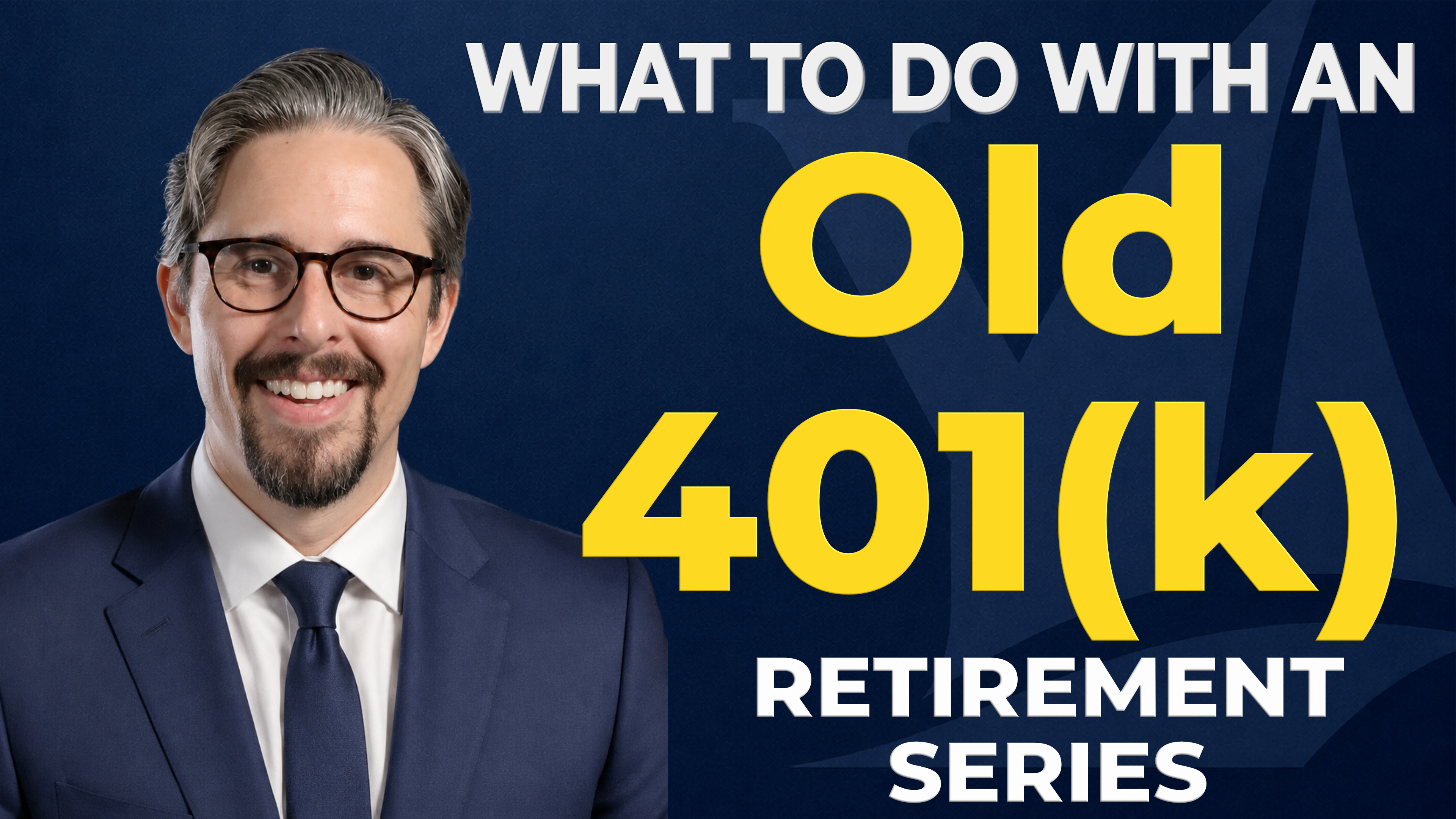
Watch: Left Your Job? What to Do With an Old 401(k)
Click here to Watch the Full Video on the Yach Advisor YouTube Channel
Transcript
What should you do with your old 401(k) when you leave your employer?
Leaving the employer could be voluntary, you could have been let go, you could have received a severance, but more than likely when you leave your employer, a triggering event happens in the plan and it becomes available.
The vested balance and the contributions that you make are available to access, either as a distribution, as a rollover, or, if you start a new job, potentially moving it into a new plan. We'll talk about all of that today.
40 or 50 years ago, changing jobs often meant leaving behind more than just your coworkers. It sometimes meant leaving behind your pension.
Many Americans spent an entire career with one employer. You worked for 30 or 40 years, you retired with a gold watch, and every month a pension check showed up in your mailbox.
Retirement planning wasn't something most employees spent much time thinking about because someone else was doing all the thinking and planning for them. The risk was on the employer.
Today, our careers look very different.
Many people won't spend their entire career with one company. They work for five, ten, or even more employers before they retire. Every promotion, every relocation, every new opportunity can leave behind another retirement account.
That's why this conversation matters.
I can't tell you how many times I've met with someone who says, "I'm pretty sure there's still a 401(k) somewhere." Maybe it's with an employer they left 10 years ago. Maybe they don't remember their login information. Maybe they aren't even sure how much is in the account anymore.
Retirement accounts have a funny way of becoming financial junk drawers.
The good news is your retirement accounts don't disappear. The money you contributed is always yours, and depending on your vesting schedule, some or all of your employer contributions may belong to you as well.
The natural next question is: Where should this money go next? How should I get my financial junk drawer in order?
Most people have four possible options.
Option 1: Leave the Money Where It Is
Sometimes that's actually a good decision.
Some employer retirement plans offer excellent investment options, low institutional pricing, or unique features that would be difficult to replicate elsewhere.
If you're happy with the plan and you don't mind having another retirement account to keep track of, leaving it exactly where it is may be a perfectly reasonable option.
You might even have a loan on the account and need to keep it open in order to avoid a taxable event. There are a lot of reasons why you might stay in the plan.
Option 2: Move It to Your New Employer's Plan
Another option is moving the money into your new employer's retirement plan.
Some people prefer having everything under one roof. It can make recordkeeping simpler, make it easier to monitor your retirement savings, and reduce the number of accounts you're managing over the course of your career.
Of course, not every employer accepts incoming rollovers. It's always important to understand the rules of your new plan.
Option 3: Roll It Into an IRA
An IRA is a little like taking your retirement savings with you after you've left the company.
You box up all the things on your desk—but do you leave the 401(k) behind, or do you take it with you?
The employer's name comes off the front door and the account becomes yours. It stays with you no matter where your career takes you.
An IRA may also provide a much broader range of investment choices than many employer-sponsored retirement plans. Instead of having a certain set of mutual funds—let's say there are 20—you may have thousands of investment options within an IRA.
Some people view that as a good thing. For others, that amount of choice can become overwhelming.
When I'm helping someone evaluate that decision, there are a number of things I want to understand:
How do the investment options compare? What are the fees? Does the employer plan offer unique benefits like a stable value fund? Would an IRA provide greater flexibility? Is there potential for lower costs within an IRA? Does consolidating accounts make life simpler?
I also want to understand how the retirement plan fits into the person's overall goals.
Do they anticipate retiring early?
Is there appreciated company stock within the 401(k) plan—in other words, is there a net unrealized appreciation opportunity?
I'm not even going to broach that topic here. If you know what it is, you know why. If you don't, just know that if you have highly appreciated company stock within your 401(k), there may be a tax strategy worth evaluating before making a rollover decision.
Another question is whether you're trying to keep nondeductible contributions separate in your IRA accounts. Rolling pre-tax money into an IRA might affect your ability to efficiently use a backdoor Roth strategy in the future.
Those are all important questions.
Notice that none of them automatically points to one answer.
Sometimes leaving the money where it is makes the most sense. Sometimes moving it to the new employer plan is the best choice. Sometimes an IRA provides the flexibility someone's looking for.
Good retirement planning isn't about finding the same answer everyone else found. In fact, one of the worst things you can do is try to find a one-size-fits-all rule from a stranger on the internet.
It's about finding the answer that fits your situation.
Option 4: Withdraw the Money
The final option is withdrawing the money.
For most people, this is the option I'd approach with the greatest caution.
If you're not yet 59½, you're not separating from your company after age 55 and qualifying under the Rule of 55, and no other exception applies, taking money out of your retirement account may create taxable income and could also result in an early-withdrawal penalty.
More importantly, you're removing money that was intended to grow for decades inside a tax-advantaged retirement account.
Never underestimate the power of opportunity cost.
What could that money have done if I had left it in the plan and allowed it to continue growing?
What Does "Rollover" Actually Mean?
Before we wrap up, I want to clear up one more common source of confusion.
Today we've been talking about rollovers. A rollover simply means moving retirement assets from one retirement account to another.
An analogy I've heard in the past is that it's like moving money from your left pocket to your right: from a traditional source to a traditional IRA, for example, or from a Roth source to a Roth IRA.
It's a reportable event, but in general, a properly completed rollover between like tax types is not a taxable event.
If you're not sure, ask before completing the rollover. There can be important tax and planning consequences depending on your circumstances.
The Biggest Takeaway
Careers change. Companies come and go. Business cards get replaced. Job titles change. Markets rise and fall.
But your retirement savings have one job: to take care of you long after your working years are over.
That's why deciding what to do with an old 401(k) deserves more thought than simply checking a box on an HR form.
If you found this video helpful, consider subscribing so you don't miss the rest of the Retirement Planning series.
Thanks for joining.
Bryan Yach, CFP®
Owner & Wealth Advisor
Yach Advisors
Yach Advisors provides this material for educational and informational purposes only. It should not be considered individualized investment, tax or legal advice. Distributions from traditional IRA's and employer sponsored retirement plans are taxed as ordinary income and, if taken prior to reaching age 59 1/2, may be subject to an additional 10% IRS tax penalty. Some IRA's have contribution limitations and tax consequences for early withdrawals. For complete details, consult your tax advisor or attorney. Converting from a traditional IRA to a Roth IRA is a taxable event. A Roth IRA offers tax free withdrawals on taxable contributions. To qualify for the tax-free and penalty-free withdrawal or earnings, a Roth IRA must be in place for at least five tax years, and the distribution must take place after age 59 1/2 or due to death, disability, or a first time home purchase (up to a $10,000 lifetime maximum). Depending on state law, Roth IRA distributions may be subject to state taxes.